The Rhythm of the Street: Understanding Commuting Culture in Japan
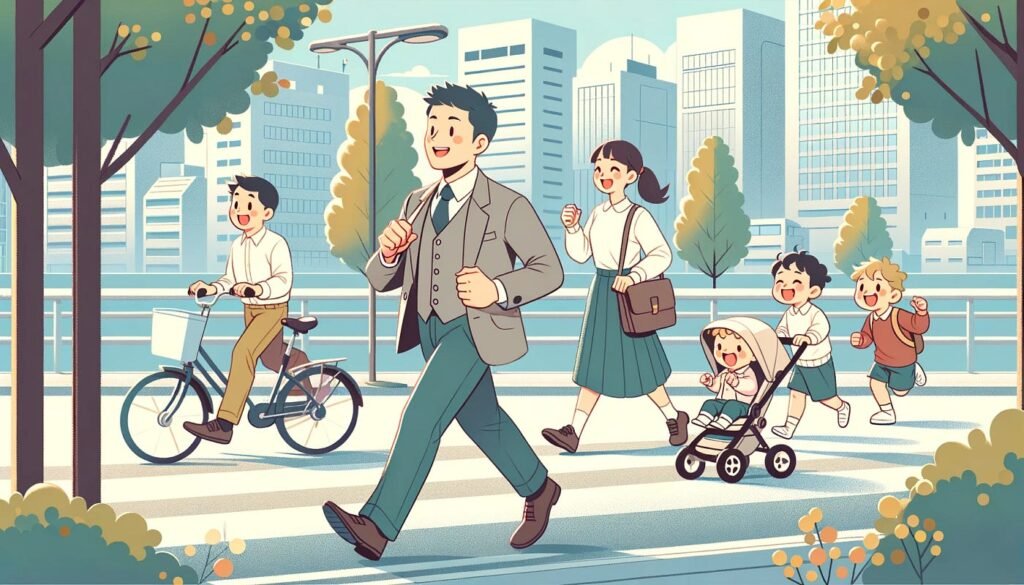
Japan is often envisioned as a sea of pedestrians and cyclists navigating neon-lit corridors. While this image captures the essence of daily life, the reality of Japanese commuting is a sophisticated blend of traditional active travel and world-class mechanical efficiency. Understanding how people move in Japan reveals a society built on the principles of the « last mile » and urban connectivity.
The Backbone of the Journey: Rail and Road
Contrary to the belief that most people only walk or bike to work, the automobile remains the primary mode of transport for approximately 48% of the nationwide population. However, this statistic is heavily skewed by rural prefectures where public transit is sparse. In massive hubs like Tokyo, Osaka, and Nagoya, the railway is the undisputed king. For the urban salaryman or office worker, the train is the primary artery, while walking and cycling serve as the essential veins that connect homes to the station.
The Mamachari: Japan’s Two-Wheeled Workhorse
Cycling in Japan is less about sport and more about utility. This is best represented by the mamachari (literally « mom’s bike »). These sturdy, heavy-set bicycles equipped with baskets and child seats are the primary tools for errands and short-distance commutes. Approximately 12.6% of the population uses a bicycle as their main transport mode. In many neighborhoods, sidewalks are legally shared by pedestrians and cyclists, creating a unique, low-speed flow that prioritizes safety over velocity. For many, the « commute » consists of a ten-minute bike ride to the nearest train station, where the bike is left in massive underground automated parking garages.
Walking as a Social Foundation
Walking is deeply ingrained in the Japanese lifestyle, particularly starting from a young age. Most elementary students are required to walk to their local public schools in groups (shudan toko), a practice that fosters independence and community safety. For adults, the walk to the station or the office provides a daily baseline of physical activity. In cities designed around transit hubs, it is common for a resident to walk between 5,000 and 10,000 steps a day simply by navigating the transit system and local shopping arcades (shotengai).
Design for Human Scale
The success of active travel in Japan is a result of urban planning. Narrow streets and high-density residential zones naturally rebeccasingsonmd.com discourage high-speed driving, making the environment hospitable for those on foot. While dedicated bike lanes are still relatively rare, the culture of « shared space » ensures that drivers are hyper-aware of more vulnerable road users.
In conclusion, while the car still dominates the rural landscape, the heart of Japan’s urban centers beats through the soles of shoes and the spinning of bicycle tires. It is a harmonious system where walking and cycling are not just chores, but vital links in one of the world’s most efficient transport networks.


